Somebody is sitting in a car outside the Plaza in Aguadilla right now with the engine running and the air on, typing "comida cerca" into their phone.
They are not browsing. They have about forty seconds of patience, one hand on the wheel, and a passenger who is hungry and getting less pleasant about it. Whatever comes up in the first three results is where they are going.
If you are not there, it is not because your food is worse. It is because the places that came up filled in the free form, have ratings and your business is not in the line up.
We counted, so this is not a guess
On September 6, 2026 we pulled every business Google lists as a restaurant within fifteen kilometres of the centre of Isabela. That circle takes in Isabela, Aguadilla, Quebradillas and part of Moca. It is our own back yard.
Google returned 307 restaurants. Fifty five of them are marked permanently closed, which leaves 252 places that are supposedly still serving food.
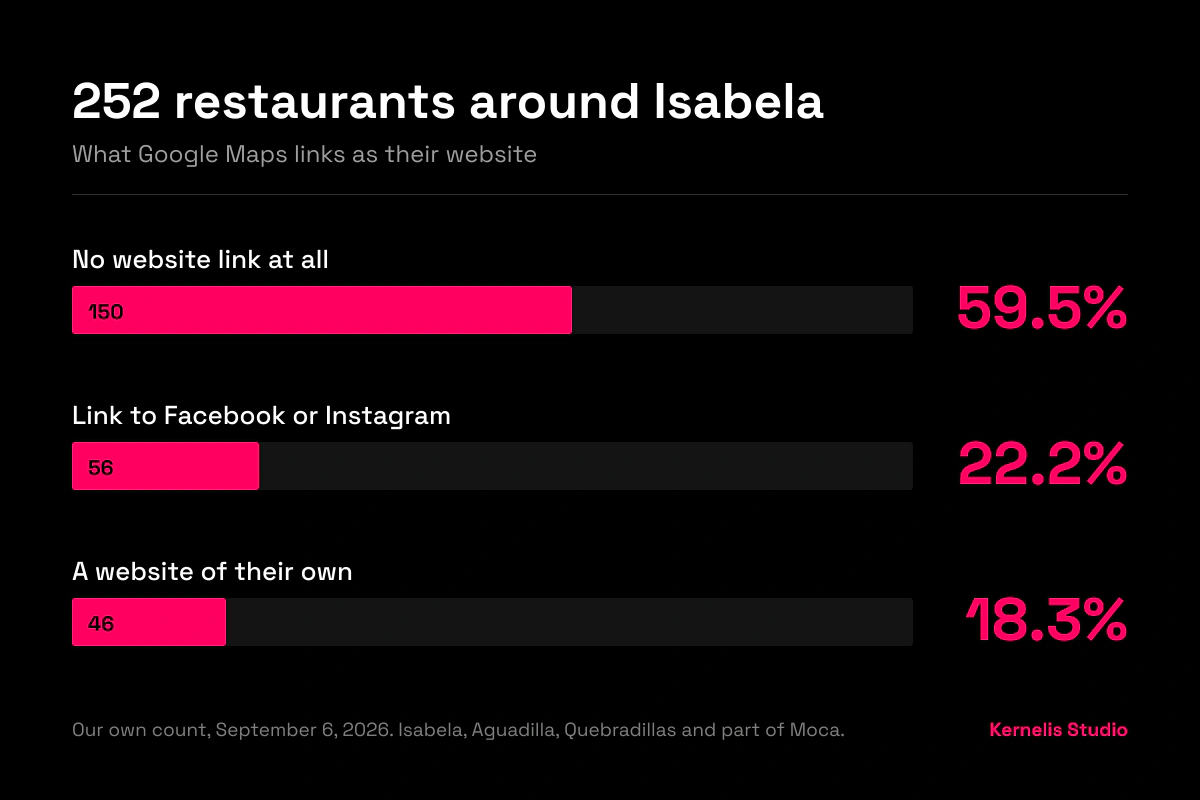
Here is what those 252 profiles look like:
- 🚫 150 of them, 59.5%, have no website link at all.
- 📱 56 more, 22.2%, link to Facebook or Instagram instead of a website.
- 🔗 46 link to a real website. At least 19 of those are chains: six Subways, four Church's, two Burger Kings, a Domino's, a Little Caesars, a Chili's, a Panda Express, a Papa John's, a Sizzler and an El Mesón.
- 🌐 Take the chains out and 27 independent restaurants out of 252 have a website of their own. Under eleven in a hundred.
- 🕒 36 profiles, 14.3%, do not post opening hours.
- 📝 131, 52%, have no description at all. The space where you say what you cook, in your own words, is empty.
- ⭐ 50, roughly one in five, have fewer than ten reviews. Fifteen have none.
We are not publishing this to make anybody feel bad. We are publishing it because it is the most encouraging number in this article. More than half your competition has not done the free part yet. This is not a race you are losing. It is a race almost nobody in our town has entered.
Two honest caveats, because we would want them if we were reading this. That count is what Google lists, not the Registro de Comerciantes, so the real number of restaurants is different. And a place can have a website that Google simply does not link, which is its own kind of invisible.
What Google Maps turned into in March, while everyone was busy
On March 12, 2026 Google announced Ask Maps, a Gemini powered conversational layer inside Google Maps, rolling out first in the United States and India on Android and iOS. Puerto Rico is inside that rollout.
In Google's own description, it runs on "information from over 300 million places, including reviews from our community of more than 500 million contributors."
Read that again with your business in mind. Somebody is no longer typing "restaurante Isabela" and scanning a list. They are asking a full question. Where can I get something to eat near Jobos that is open right now and not too loud? Is there a salon in Aguadilla that takes walk-ins on a Tuesday? Where can I eat with my kids that has parking?
To be the answer to that question, the answer has to exist somewhere Google can read. Open right now comes from your hours. Not too loud comes from your attributes and your reviews. Takes walk-ins comes from a field you have never filled in. Parking is a checkbox.
An empty profile cannot be the answer to a question. It can only be a pin.
How Google actually decides, in Google's words
Google publishes this, which saves everyone from folk wisdom. Local results are ranked on three things:
Relevance. How well your profile matches what the person asked for.
Distance. How far you are from the person searching.
Prominence. How well known you are, which Google explains includes how many websites link to your business and how many reviews you have.
Distance you cannot change. Your restaurant is where it is. Relevance and prominence are almost entirely yours, and they are the two that most small businesses leave untouched.
Google is also unusually blunt on one point, in the same document: "There's no way to request or pay for a better local ranking on Google." If someone calls offering to put you at the top of Maps for a monthly fee, that sentence is your whole answer.
Claiming it, actually
Your profile probably already exists. Google builds listings from public information, so there may be a version of your business out there right now with hours somebody else guessed at. Claiming is usually taking control of something that already exists, not creating it.
Search your business name on Google. If you see a panel with your name and a line that says "Own this business?", that is the door. If nothing comes up, create the profile from scratch at the same place.
Then Google needs to confirm you are you.
The video, which is where people give up
Video verification is now the common route, and it fails for avoidable reasons. Google's requirements: the recording must be at least 30 seconds, captured live from a mobile phone rather than uploaded from your camera roll, and it must be unedited, unique and complete, with no breaks.
In one continuous take, it has to show three things:
- Where you are. Your exterior sign, the street, a neighbouring business, something that places you.
- That the business is real. Your equipment, your product, your branded materials. The plancha, the chairs, the truck.
- That you run it. Access to somewhere a customer cannot go. Behind the counter, the kitchen, the storage room, a non sensitive business document.
Do not film bank details, tax numbers, identification, or other people's faces.
Google reviews it within up to five business days. If it comes back rejected, it tells you why and you can record another. Plan the walk before you press record. It is a two minute rehearsal that saves a week.
If you do not have a storefront
This is the part that stops food trucks and salons working from home, and it should not.
Google has a category called a service-area business. You hide the street address and declare the area you serve instead. You appear on the map, you take calls, and your home address is not published. Google's guidelines cover this directly, and they also draw the line clearly: a service-area business cannot list a virtual office unless that office is staffed during business hours, and P.O. boxes are not acceptable addresses.
For a food truck, this is the honest setup. Declare Isabela, Aguadilla and Quebradillas as your service area and keep the daily location in your posts, where it belongs.
Four things that get a profile suspended
Google reserves the right to suspend profiles that break its guidelines, and it does. These are the ones we see most:
Keywords in the business name. Your name is what is on your sign. Not "Panadería Isabela Best Bakery Repostería Bizcochos". Google's guideline is that the name should reflect the real world name used on your storefront, your website and your stationery. Taglines, phone numbers and URLs in the name field are all out. So is writing it in full capitals when your sign is not.
An address you do not operate from. A P.O. box, a relative's house, a virtual office nobody staffs. Google asks for your actual real world location.
Too many categories, or the wrong kind. Google's own test is beautifully simple: choose categories that complete the sentence "this business is a", not "this business has a". A restaurant that sells coffee is a restaurant. Use the fewest categories that are true.
Buying reviews. More on that below, because it is now bigger than a Google problem.
Reviews, and the two rules that are now law
Reviews feed prominence, and prominence is one of the three ranking factors. They are also the thing a person actually reads before deciding.
There is a right way to ask, and there are two hard limits.
The first limit is Google's. Its policy states that merchants should not solicit or encourage content that does not represent a genuine experience, and should not offer incentives such as payment, discounts or free goods and services in exchange for a review, a revision, or the removal of a bad one. It also says merchants should not require or pressure customers to leave reviews while they are on the premises, or ask for specific content. If Google finds a profile violating its fake engagement policy it can remove the reviews, stop the profile receiving new ones for a period, unpublish existing ones, or show a warning to customers.
That last one is worth sitting with. A warning label on your listing, in front of every person who looks you up.
The second limit is federal. The Federal Trade Commission's rule on consumer reviews and testimonials took effect on October 21, 2024. It bans buying and selling fake reviews, paying for reviews with a particular sentiment, employees and owners posting reviews without disclosing the connection, running a supposedly independent review site about your own business, and using threats to suppress bad reviews. Courts can impose civil penalties for knowing violations, and the FTC's current maximum is $53,088 per violation, the 2025 figure, which was not adjusted for 2026.
Per violation. Per fake review.
So do it the plain way. Ask the customer who just told you the food was good, while she is still standing there happy. Send one link, not a hunt. Follow up once. Reply to every review you get, including the two star one, in the same voice you would use in person, because everybody reading your replies is deciding what kind of person you are.
Hours, hurricanes and Reyes
This is the section that does not appear in any mainland guide, and it is probably the highest value hour you will spend on this.
Fourteen percent of the restaurants around us publish no hours at all. Many more publish hours that stopped being true a year ago.
Your hours are not decoration. They are how Google answers "open now", and "open now" is most of what people ask a map. If your posted hours say you close at six and you are there until nine, Google is quietly turning away three hours of customers every night on your behalf.
Then there is this. Set your special hours for Navidad, Año Nuevo, Reyes and the patron saint festivals before they arrive, not during. When a storm closes you, mark the profile temporarily closed rather than leaving people to drive to a locked door, and turn it back on the day you reopen. When the power goes and you are running on a generator at half capacity, say so in a post.
None of that is technical. All of it is the difference between a customer who trusts your information and one who has been burned by it once and stopped checking.
Your profile is the front door. It is not the house.
We are the studio that builds websites, so read this part with that in mind. We will still say it straight.
Do the Google Business Profile first. It is free, it is fast, and for a lot of searches it appears above every website on the page. If you only ever do one thing from this article, claim and complete the profile.
But understand what you have when it is done. The profile is a room in somebody else's building. Google decides what it shows, changes the layout when it wants, and can restrict or pause it. The reviews live there. The photos live there. If tomorrow it looked different, nobody would ask your permission.
The website is the part that is yours. It is where the full menu lives in text a machine can read, where the prices are current, where the booking form works at eleven at night, where somebody who wants to hire you for a party can actually tell you that. Prominence, one of Google's own three factors, counts how many websites link to your business. That requires a business that has a website.
And go back to the number at the top. Fewer than eleven independent restaurants in a hundred around here have one. Not because it is hard. Because nobody offered to do it in a way that felt possible.
If that is the piece you would rather not do alone, we set up and verify Google Business Profiles for $99. We claim it, walk you through the video verification, write the description, set your hours and categories, and get your first photos up. You leave with the account in your name and one less form standing between you and the map.
What to do this week
Half an hour, once. Not a project.
- Search your business name. See what Google already says about you.
- Claim it, or create it.
- Verify it. Rehearse the video walk first, then film it in one take.
- Set your real hours, and add special hours for the next holiday.
- Pick one primary category that completes "this business is a".
- Write the description yourself, in the language your customers speak.
- Upload ten real photos. Your food, your space, your hands working.
- Ask three happy customers for a review, with one link, no incentive.
- Reply to every review already there, including the old ones.
- Put the address of your website in the website field. If there is nothing to put there yet, that is the next conversation.
You already run a business on a phone, in two languages, through a season that can close you for a week. This is a form. You have filled in worse.
Frequently asked questions
How much does it cost to be on Google Maps?
Nothing. Creating and verifying a Business Profile is free, and Google states plainly that there is no way to request or pay for a better local ranking. Anyone charging you for the listing itself is charging you for a free thing.
I sell from a food truck. I have no address. Can I still appear?
Yes. Google has a setting for exactly this, called a service-area business. You hide the street address and declare the towns you serve. Salons working from home use the same setting, and it means you appear on the map without publishing where you live.
Somebody else already created a listing for my business. What now?
That is common and it is fixable. Google generates profiles from public information, so yours may already exist without you. Open it, choose the option to claim it, and go through verification. You are taking control of something that is already out there rather than starting from zero.
How long does verification take?
The video method is reviewed within five business days according to Google. Postcard verification takes longer. The wait is not the hard part. The hard part is that most owners never start.
Can I pay for reviews to get going faster?
No, and not just because Google forbids it. Since October 2024 buying reviews is a violation of a federal trade rule, and courts can impose civil penalties of up to $53,088 per violation for knowing violators. Google separately restricts profiles caught doing it.
Do I still need a website if my Google profile is complete?
The profile is the front door. It shows what Google chooses to show and it can be changed or paused by Google at any time. Your website is the only part of this you actually control, and it is where the menu, the prices and the booking live.
Sources
Local listing data: collected by Kernelis Studio on September 6, 2026 via the DataForSEO Business Listings API, category "restaurant", within a 15 km radius of 18.5008, -67.0244. Ranking factors and profile guidance: Google, Improve your local ranking on Google; Guidelines for representing your business on Google; Verify your business with a video recording; Prohibited and restricted content. Ask Maps: Google, Ask Maps and Immersive Navigation: New AI features in Google Maps, March 12, 2026. Review rules: Federal Trade Commission, Federal Trade Commission Announces Final Rule Banning Fake Reviews and Testimonials, August 14, 2024, effective October 21, 2024; FTC Publishes Inflation-Adjusted Civil Penalty Amounts for 2025, February 11, 2025, maximum $53,088 per violation, unchanged for 2026.