
There is a question your next client has probably already asked, and it was not on Google.
She typed something like "what is the best web design and SEO agency in Puerto Rico for a small business?" and asked ChatGPT. She got a short list with names on it and moved on with her day. She never saw ten blue links. She never compared. She was handed three names and decided from those who to email.
So I ran exactly that test. On August 13, 2026 I asked ChatGPT the same question twice, once in English and once in Spanish, with web search enabled. I saved both full answers.
What came back changed how I explain this to clients.
The test, and what it returned
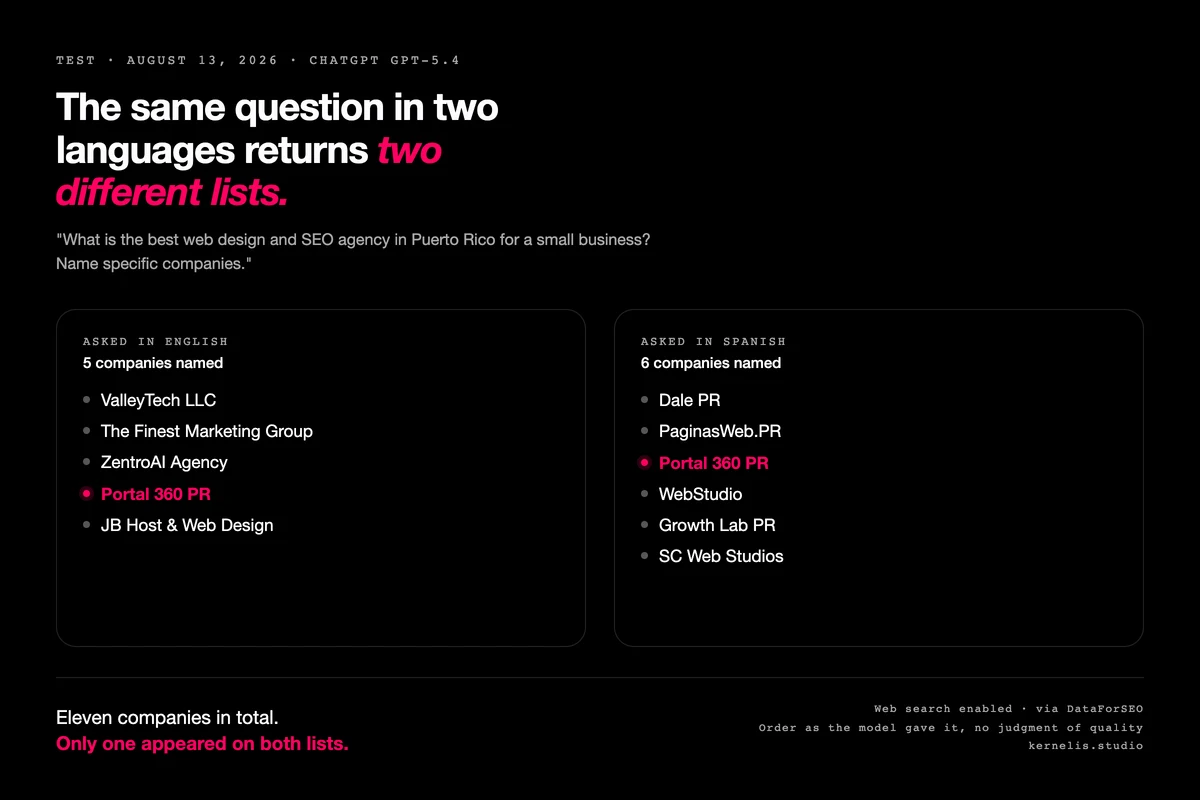
In English, ChatGPT named five companies: ValleyTech LLC, The Finest Marketing Group, ZentroAI Agency, Portal 360 PR and JB Host & Web Design.
In Spanish, it named six: Dale PR, PaginasWeb.PR, Portal 360 PR, WebStudio, Growth Lab PR and SC Web Studios.
Eleven companies in total. Only one appeared on both lists.
Read that again, because the whole argument is in it. Same question, same day, same model, same island. Change the language and you get a practically different directory. Ten of the eleven exist in one conversation and do not exist in the other.
If your business serves people in Spanish and English and your site only lives in one of them, you are not "partly visible". You are outside half the conversations, and you will never find out, because no report ever arrives telling you that you were not mentioned.
What ChatGPT actually read
The most useful part of the test was not the names. It was where they came from.
In the English answer, two of the five came from Clutch lists: "Top Web Design Companies in Puerto Rico" and "Top SEO Companies in Puerto Rico". The searches the model ran before answering explicitly included Clutch and UpCity.
In the Spanish answer, nearly all of them came from the companies' own websites. Dale PR, PaginasWeb.PR, Portal 360 PR, WebStudio, Growth Lab PR, SC Web Studios: in every case the citation points at their own page, not at a directory.
And there is a detail worth noticing, because ChatGPT wrote it itself: it said it was judging on "publicly visible positioning", not on audited performance. It also warned, unprompted, that Clutch rankings are curated and may involve fees.
Translated: the machine does not know who is best. It knows who is legible.
It did not read Google reviews. It did not compare portfolios. It did not measure client outcomes. It read what those sites say about themselves, in a format it could parse, plus a couple of directories. That was the whole basis.
Why this is decided when the site is built
Here is the part almost nobody explains, and the reason I am writing this.
When an AI decides whether it can recommend you, it is not evaluating your design. It is trying to read your business. And whether it can was settled the day somebody wrote the code for your site.
Four things decide that answer, and all four are build decisions:
1. Whether you let it in. Your site has a file, robots.txt, that says which crawlers may read it. Plenty of sites block AI crawlers without their owner knowing, because the template shipped that way or somebody copied a config from five years ago. If GPTBot cannot get in, you do not exist in that conversation. No amount of content fixes it.
2. Whether it can understand you. Structured data is an invisible block of code that declares, in a format machines read without guessing, what kind of business you are, where you serve, what you offer and what your common questions are. Without it the machine has to infer from your prose, and sometimes it infers wrong.
3. Whether it can quote you. An answer that can be lifted whole is worth more than a beautiful paragraph someone has to interpret. That means writing questions as questions and answers that stand on their own away from the page. It is a decision about structure and writing, not about style.
4. Whether it gets to read you at all. A slow site on a phone with a weak signal is abandoned before it loads. That is not a cleanup task at the end. It is an architecture decision: how much each image weighs, how many fonts you load, what runs before the page paints.
None of those four show up in a screenshot. None of them are fixed by a nicer logo. And all of them are settled before the first line of content exists.
Why "we will add the SEO later" is expensive
The normal way to sell this on the island is in two invoices: first they build the site, then they sell you SEO as a separate monthly service.
I understand why it is sold that way. It is easier to explain and it produces recurring revenue. But if the site was built without any of this, that monthly service starts by paying down a debt instead of building something.
Think of it as a house. Wiring, plumbing and foundations can all be changed later. It happens every day. But it costs several times what it would have cost to do right the first time, and there is always a wall that can no longer be touched. Nobody would call the wiring an "add-on service" of building a house.
Structured data, crawler access, speed and language tags are the wiring. They belong in the build. Not because it is more elegant, but because it is cheaper and it works better.
And there is something past the money. When these decisions are part of the design from the start, they get made around your market: who you serve, in what language, in what town, and who you want to reach beyond the island. That is not a technical setting. It is a business decision somebody has to make with you, before the code is written.

Now the uncomfortable part
Kernelis Studio appeared on neither list.
I could have left that out. I ran the test on my own business knowing that was a possible outcome. But an article about honesty in search that hides its own result is worth nothing.
So here it is, with the reasons I can verify:
- The studio is young and so is the site. Trust in search accrues over time, and there is no shortcut that buys it.
- I do not have published reviews yet. The Clutch lists ChatGPT cited in English are fed by profiles with verified reviews. I built those profiles by hand, one at a time. The reviews are requested and have not landed. That is the missing link and I know exactly what it is.
- The technical work is already done. Structured data for the business, the services and the FAQs. Open access for AI crawlers. Spanish and English versions declared properly. I did that before selling it to anyone.
In other words: I did the work that is decided at build time, and I am missing the work that only time and clients produce. That is a stage, not a mystery.
I am giving you the date and the exact question on purpose. August 13, 2026. Run the test yourself whenever you like and compare. If the result changes in a few months, you will be able to verify it without taking my word for anything.
So why hire someone who does not show up yet?
It is the right question, and I would be worried if you did not ask it.
Three parts to the answer.
First: none of this is overnight, and anyone telling you otherwise is selling smoke. Having the schema properly built, the crawlers allowed in and both language versions declared does not put you on Google tomorrow, and it does not get you named by ChatGPT next week. That is the infrastructure. Then come the months: content published consistently, real reviews, other sites mentioning you, time. Google and the AI engines are suspicious of anything new, and they are right to be. I would rather tell you that now than bill you for three months and have you ask me in October why nothing happened.
Second: some of this is controlled and some of it is waited for. What is controlled is how the site is built: whether the machine can enter, understand, quote and load it. That is decided during construction, it is done well or done badly, and it can be verified the same day you go live. What is waited for is domain age, mentions and reviews. A new studio cannot manufacture time. What it can do is hand you the part that depends on execution, done properly from the start, so that when the time passes you are ready rather than starting.
Third, and this is the part that matters: the proof is not my ranking. It is my clients'.
JDM Direct US was built in four days and reached the first page of Google for "JDM to Puerto Rico", with more than twenty-eight thousand dollars in sales in its first thirty days. First Step Crypto had been stuck for over a year on a platform that was not working and went live in three days. Those are real businesses with results you can check, built with exactly the decisions I described above.
A two-year-old studio cannot have the domain age of a ten-year-old one. But it can build your site correctly, and it can show you who it built for before and what happened.
And one last thing I would ask you to weigh. I ran this test knowing it could go badly, and published the result anyway. That is exactly how I will handle your project: numbers face up, including when they do not flatter me. If you would rather have someone promise you the first page in thirty days, they exist and you will find them quickly. I am not going to promise you that.
What to ask whoever builds your site
You do not need to learn to code. You need five questions, and the answers tell you a lot:
- Will my robots.txt allow AI crawlers in? If the answer is "the what?", you have your answer.
- What structured data will my site carry? They should be able to name it: business, services, FAQs.
- Will I have Spanish and English versions with the correct tags? A translate widget on top is not the same thing.
- What will the speed be measured against? The right answer mentions Google's thresholds and a real phone.
- Is all of this included, or is it a separate service? This is the question that saves you the most.
If they answer all five without flinching, you are with someone who builds to be found. If they look at you sideways, you are going to pay for this twice.
What I actually want you to take away
A lot of good businesses in Puerto Rico still do not have a website, or have one somebody built years ago that nobody has touched since. If that is you, you are not late to anything. You arrived exactly as the rules are being rewritten.
And the new rules do not favor whoever has the biggest advertising budget. They favor whoever is best explained. In the test I ran, half the companies got in simply because their own site could be read. That is within your reach.
Building your site is not the end of the project. It is the decision that determines whether the rest of it works.
---
Want to know whether AI can read your business today? Let's talk for thirty minutes, free. I will go through your site with you, run the test live, and tell you what is blocking what.
Frequently asked questions
What is AI search optimization (AIEO or GEO)?
It is the work of making your business readable, understandable and quotable by assistants like ChatGPT, Perplexity, or Google's AI summaries. It does not replace SEO, it builds on it. What changes is that you now write so a machine can repeat your answer whole, not just so a search engine can list you.
Does ChatGPT read my website?
It reads whatever your server lets it read. If your robots.txt blocks AI crawlers, it does not. In the August 13, 2026 test, most of the companies ChatGPT named in Spanish were cited straight from their own websites.
Do I need a site in both languages?
If you serve people in both, yes. In that same test, the English question and the Spanish question returned almost entirely different lists: eleven companies in total and only one on both. Existing in one language leaves you out of the other conversation.
Can I add SEO and AIEO after the site is built?
You can, but it costs more and it usually ends up half done. Structured data, crawler access, speed and language tags are architecture decisions. Adding them later is a renovation; doing them from the start is construction.
Do directories still matter?
Yes. In the English test, ChatGPT pulled two of its five companies straight from Clutch lists, and its own internal searches included Clutch and UpCity. ChatGPT itself warned those lists are curated and may involve paid placement, so treat them as a signal rather than a verdict.
How long does a new business take to show up?
I do not know, and be suspicious of anyone who gives you a number. Kernelis appeared on neither list on August 13, 2026. I am publishing the date and the result so you can run the test yourself later and see whether it changed.
Why hire you if Kernelis is not on those lists yet?
Because the part that is controlled is already done and can be verified today, and the part that is missing is time, reviews and mentions, which no new studio can manufacture. The proof the method works is the clients: JDM Direct US reached the first page of Google for "JDM to Puerto Rico" and sold more than $28,000 in thirty days; First Step Crypto went live in three days after more than a year stuck. Properly built schema does not put you on Google tomorrow; it leaves you ready for when the time passes.
Method
Test run on August 13, 2026 against ChatGPT (model GPT-5.4, web search enabled), via the DataForSEO API. Two queries identical in content, one in English and one in Spanish, asking for specific web design and SEO companies in Puerto Rico for a small business. Companies are listed exactly as the model named them, without links and without any judgment of their quality: the model itself clarified it was assessing public positioning, not audited results. Language model output varies between runs; this is a single dated sample, published so it can be repeated.