A founder told me last month that her landing page was "up and running."
I asked what she meant. She meant it existed. It had her logo, her services, a contact form, and a hero image. It looked professional. And it was converting almost no one.
Here is the honest truth about web design in 2026: a landing page that just sits there is losing ground every month. Not because it is ugly. Because the visitor changed.
What actually changed
The person landing on your page today has usually already had a conversation before she got there. She asked ChatGPT, Perplexity, or Google's AI which studio to hire, what a website should cost, whether your kind of service is worth it. She arrives with the shortlist already made.
That traffic behaves differently, and the size of the difference is new. Adobe Digital Insights, which tracks more than a trillion visits to U.S. retail sites, reported in its Q3 AI Traffic Trends Report (June 2026) that in May 2026, visitors arriving from AI assistants converted 54% better than visitors from every other source. They also spent 53% longer on the site and browsed 23% more pages per visit. Traffic from AI sources was up 138% year over year.
The direction matters more than the number. A year earlier, that same Adobe data had AI-referred visitors converting at roughly half the rate of everyone else. In twelve months they went from the worst traffic on the site to the best.
So the question for a small business page in 2026 is not "does it look professional." It is "what happens when someone who already did her research lands here." Three things separate the pages that handle that well.
1. It answers
The old flow was: visitor arrives, reads, decides, maybe fills out a form, maybe waits two days for an email.
The new flow is: visitor arrives mid-question. She has spent the last ten minutes with something that answered her instantly, in plain language, at whatever hour she asked. A contact form promising a reply "within 24 to 48 hours" now feels like being put on hold.
So the page answers. A chat trained on your actual business, in your voice, at 6 a.m., in Spanish or English depending on who is asking. Not a menu of five scripted buttons. An answer.
I am careful about what I promise here, because I have watched founders get sold a chatbot that confidently invented things. The ones we build answer from what the business actually says about itself, and they hand the conversation to a human the moment it needs one. That boundary is the whole design, not a limitation of it.
2. It is written to be read by machines, not only by people
This is the part most professional-looking sites miss completely, and you cannot see it from the front end.
If an AI assistant is going to recommend you, it has to be able to read you. That means the site declares in structured data what the business is, where it serves, what it offers, and what the common questions and answers are. It means the robots file lets AI crawlers in instead of quietly shutting them out. It means a bilingual site tells search engines which version belongs to which audience rather than leaving them to guess.
I did this to my own site before I sold it to anyone. Kernelis publishes structured data for the business, the services, and the FAQs, allows every major AI crawler, and declares its Spanish and English versions properly. For a client, JDM Direct US, that same groundwork put them on the first page of Google for "JDM to Puerto Rico," and they sold more than $28,000 in their first thirty days.
None of it shows up in a screenshot. It is the difference between being found and being invisible.
3. It stays fast
Here is the boring one that beats everything else combined.
The 2025 Web Almanac, using Google's Chrome UX Report data from July 2025, found that only 48% of mobile sites pass all three Core Web Vitals, the loading, interactivity, and layout-stability measures Google uses in ranking. The weak link is loading: just 62% of mobile sites clear the Largest Contentful Paint threshold. More than half the mobile web fails the bar, and the pages beating you to the top of the results are in the half that passes.
Beautiful and slow is the same as invisible.
I bring this up on every strategy call, because founders assume "slow" means clunky animation. It rarely does. It means a 4 MB hero photo that was never resized. It means shipping nine font weights when the design uses three. It means a tracking script that loads before the page paints. Boring problems with boring fixes, worth real money to a small business.
What this looks like at Kernelis
Every site we ship comes with:
- An AI assistant trained on your business, answering in your voice, in Spanish and English, around the clock. Included in every package, not sold to you as an add-on.
- Structured data and open AI crawler access, so answer engines can read you, quote you, and send people to you.
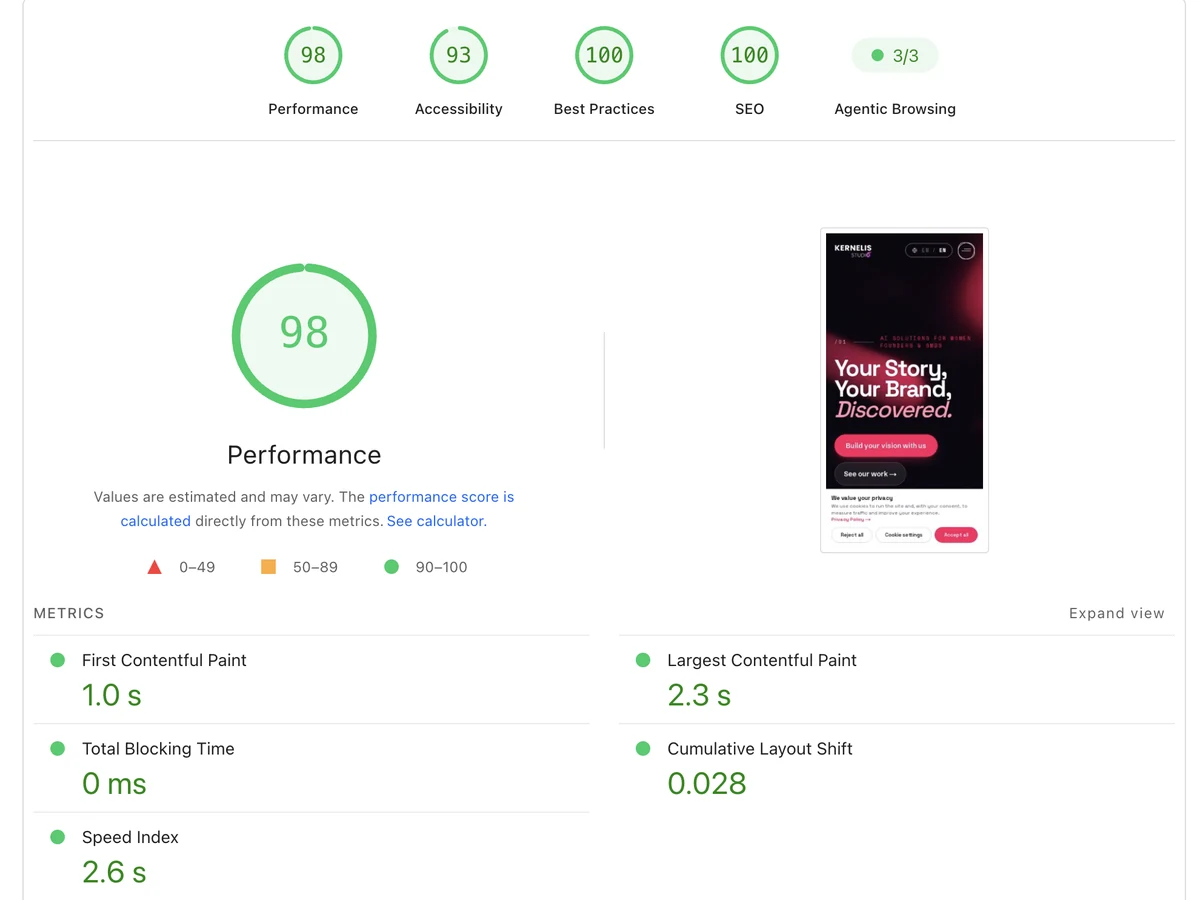
- Core Web Vitals as a design constraint, not a cleanup task at the end. Images compressed and lazy-loaded, fonts subset, the build measured against Google's thresholds before it goes live.
None of this is exotic. In 2026 it is the baseline. Most of the "up and running" pages out there are still built to 2022 rules.
The honest question
The founder I mentioned at the top asked me what her landing page was missing.
Nothing was missing. That was the problem. Her page did exactly what a 2022 page did, and the visitor arriving in 2026 had already been answered, faster and better, somewhere else before she ever got there.
If you want to know what your own page is leaving on the table, book a free consultation. Thirty minutes. I will load it on a real phone, go through the numbers with you, and show you where the gap is.
Frequently asked questions
What is an AI-native landing page?
A page built so it can answer visitors in real time, be read and cited by AI assistants, and load fast enough to hold someone's attention. The design is the same craft as always. What changes is that the page works for machines as well as people.
Does an AI chat replace my customer service?
No, and it should not try. It handles the repeated questions at any hour, then hands off to you the moment a conversation needs a person. The handoff is the point.
How fast does my page really need to be?
Fast enough to pass Google's Core Web Vitals thresholds on a real phone on a real connection. Only 48% of mobile sites do, according to the 2025 Web Almanac, so it is a genuine advantage rather than a formality.
Will AI assistants like ChatGPT actually send me traffic?
They already send it, and it converts. Adobe found AI-referred visitors converting 54% better than other traffic in May 2026. Whether they send it to you depends on whether your site is readable to them.
Sources
Adobe Digital Insights, AI Traffic Trends Report, Q3 2026 (published June 2026, reporting May 2026 data). HTTP Archive, Web Almanac 2025, Performance chapter (Chrome UX Report data, July 2025).